Know the ISO Cleanliness Code - Extend Component Life
Stop premature equipment failure. Learn how particle count control and proactive lubricant maintenance directly extend component life and reduce downtime.

A particle count result on a lubricant analysis report is often considered the second most important piece of information after the viscosity test result. Today, an ISO 4406 Cleanliness Code is the most common unitless result to measure oil cleanliness in systematic fashion. A typical test result of 19/17/14 is a good example – three numbers in descending order with a forward slash between them. By understanding this coding system, it becomes easier to set goals to improve oil cleanliness throughout your facility or plant.
To better understand the ISO 4406 Cleanliness Code let’s look at the scale of what we are measuring. The smallest visible particle for a normal vision human eye is approximately 40 microns. One micron is equivalent to 0.00003937 inches or 0.001 millimeters. The width of human hair is approximately 40 to 80 microns and a grain of table salt is about 100 microns. Surprising, very surprising for many people, the clearance in lubricated machinery may be as small as 1 to 10 microns, depending on the application.
Hard particles in a lubricated system that can cause the most wear damage are roughly the same size as the clearance between contacting lubricated equipment. Particles that are smaller than clearance will pass through the lubrication regime without damaging critical components, since they safely fit between the surfaces when passing through. Particles that are larger than a clearance cannot fit through the opening and are less likely to create abnormal wear.
The ISO Cleanliness Code System
The ISO 4406 Cleanliness Code provides a concise method to report the number of solid particles in a fluid. The three numbers (number slash number slash number) represent the quantity of particles at a specified size threshold per one milliliter of fluid:
The first number: All of the particles in one milliliter of sample that are than 4 microns. This is a cumulative count, which means that it also counts all particles greater than 4 microns as well as particles greater than 6 and 14 microns.
The second number: All of the particles in 1 milliliter of sample that are greater than 6 microns. This is also a cumulative count, which means that it also counts all particles greater than 6 microns as well as particles greater than 14 microns.
The third number: All the particles in 1 milliliter of sample that are greater than 14 microns in size.
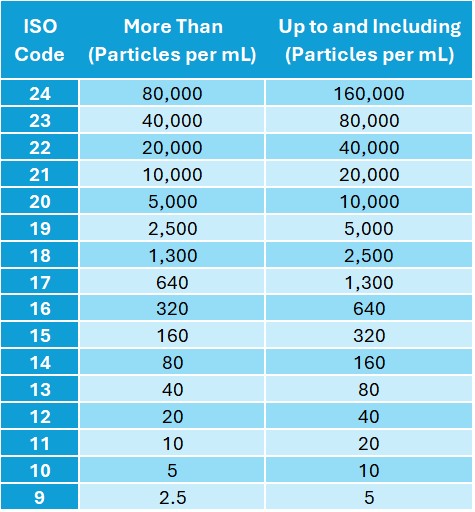
Size range categories are on a logarithmic scale, see Table 1 below.
Table 1. ISO 4406 Codes
For example:
A particle count of 350 particles per mL off sample in the size range of >4 microns is an ISO Cleanliness Code of 16.
A particle count of 90 particles per mL off sample in the size range of >6 microns is an ISO Cleanliness Code of 14.
A particle count of 18 particles per mL off sample in the size range of >14 microns is an ISO Cleanliness Code of 11, which generates an ISO Cleanliness Code of 16/14/11.
If you can reduce your particle count by one ISO code, you have reduced the number of particles by half. Is it worth the effort to take steps to lower an ISO Cleanliness Code of an in-service lubricant? How do I achieve this cost effectively? Upgrading lube system breathers, deploying offline kidney-loop filtration carts, and meticulously pulling oil samples from live equipment takes time, money, and discipline. For a maintenance team already stretched thin putting out fires, it can feel like a lot of extra effort.
The Multiplying Effect (Snowball Effect) of hard particle contamination damage
When clearance-sized particles are trapped between two moving metal surfaces they do not pass through without negatively affecting the material over time. As the machine operates, these hard particles gouge metal, generating new wear particles, which then get caught in the clearance and create even more wear. This snowballing destructive chain reaction is the root cause of:
Abrasive Wear: Literally machining away the internal surfaces of your pumps, journals, and valves.
Surface Fatigue: Micro-cracking under extreme pressure that eventually leads to catastrophic bearing spalling.
Sluggish Hydraulics: Silt build-up that causes tight-tolerance valves to stick, drastically reducing equipment performance and precision.
By defining and fighting for specific ISO cleanliness targets, you essentially take control of the machine's lifecycle.
The Effort: It requires investing in high-efficiency filters, sealing systems with quality desiccant breathers, and filtering new oil before it goes into the machine (because new oil is typically not as clean as expected).
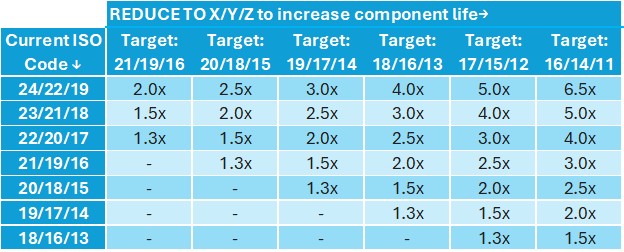
The Reward: Review the Equipment Life Extension Matrix below. Improving oil cleanliness and lowering the ISO Cleanliness Code from a heavily contaminated 22/20/17 result to a clean 18/16/13 result can increase component life by 2.5 times.
Table 2. Life Extension Matrix
Know Your Baseline, Set Goals, Make the Difference
You cannot manage what you do not measure. You can install the best filtration systems in the world, but without accurate, routine fluid analysis, you are simply guessing at your machine's health.
Increase component life by improving oil cleanliness. Set goals to reduce the ISO Cleanliness Code of in-service lubricants across the plant. Step one is establishing a baseline. Step two is setting a short term and long-term goal for lower particle count test results, taking into account budgetary needs of equipment and people time. Lastly, establish buy-in and train the team.
Always aim to collect oil samples that represent the fluid that is actively lubricating a unit. Usually a sample of actively lubricating oil is much cleaner than oil out of a drain, so sample in the best location, using the best technique when starting the quest to lengthen component life through improved oil cleanliness.
Stop letting microscopic dirt dictate your maintenance schedule. Check your latest oil analysis report, find your ISO cleanliness codes, and start taking control of your equipment's lifecycle.